
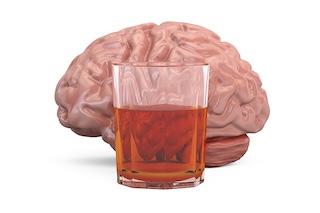
 A new study published in the American Journal of Pathology looked at how inflammation in the brain plays a role in alcohol use disorder.
“We were hoping to find out if microglia, immune cells in the brain, contribute to negative feelings found in people with an alcohol use disorder,” study author Leon G. Coleman told us. “We had a theory that microglia would contribute to anxiety and fear memories after heavy alcohol use.”
According to the Centers for Disease Control and Prevention, in the US, about 178,000 people die from excessive use of alcohol annually. Over 50% of adults in the US consume alcohol and 17% binge drink. Binge drinking is defined as a man consuming over five drinks and a woman consuming over four drinks in one sitting.
There are few effective treatments for alcohol use disorder. Negative feelings are thought to contribute to the disease, and inflammation in the brain is known to occur in humans with the disease. The research team tested if the inflammation promotes the negative feelings.
“We put mice through binge alcohol treatment with and without inhibiting the microglia activation,” Coleman told us. “We then tested measures of anxiety and fear memory after alcohol.” The researchers found that negative emotions and proinflammatory activation in the brain lasts weeks into abstinence from alcohol. If brain inflammation was prevented by targeting microglia, the negative emotional states caused by alcohol were prevented.
“We were a little surprised at the protection,” Coleman told us. “We usually think about neurons as causing most brain problems, but this implicates inflammatory signaling.”
Coleman believes the findings open new avenues to consider for treating features of alcohol use disorder and that targeting inflammation in the brain could be protective.
“It is important for people to know that heavy drinking can have long lasting consequences on their emotions and their brain function,” Coleman told us. « We should realize that ‘becoming an alcoholic’ is not the only risk associated with heavy drinking. Even if we can ‘control’ our drinking, our drinking has the potential to control our emotions and to promote inflammation in our brains.”