
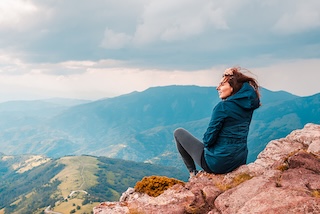
 A new study published in the Journal of Neuroscience and Biobehavioral Reviews looked at the neuroscience of nature exposure.
“We looked across 108 peer-reviewed neuroimaging studies to understand what happens in the brain when people are exposed to natural environments, whether that is in real outdoor settings, in the lab, or through virtual reality,” study author Mar Estarellas told us. “We wanted to move beyond the general idea that nature is good for us, and ask a more precise question: What are the neural mechanisms that might help explain those benefits?”
Based on existing theories such as the Stress Recovery Theory and Attention Restoration Theory, the researchers expected that nature exposure would be associated with reduced stress-related brain activity, lower cognitive load, and neural patterns consistent with attentional restoration. At the same time, because the field is still relatively young and methodologically diverse, the researchers were also careful not to expect a perfectly uniform picture. What interested them most, explained Estarellas, was whether a coherent pattern would emerge across different brain-imaging methods.
“Personally, one of the reasons this topic feels so important to me is that so many people already know, intuitively and through their own experience, that time in nature helps,” Estarellas told us. “A walk outside, the sound of the sea or a few quiet minutes in a park; these things often make us feel better, even if we do not fully understand why. Scientifically, I felt there was a real need to bring together the emerging neural evidence and ask what kind of brain-based account is beginning to take shape.”
Estarellas believes this topic sits at the intersection of several issues that matter deeply today: mental health, urban living, environmental design, and our relationship with the natural world.
“Personally, now that I have just had a baby, the question of how we care for this world feels more important than ever,” Estarellas told us. “I hope that by gathering more evidence of how deeply connected we are with nature, we may also help more people recognize its value and feel moved to care for it better.”
To conduct their study, the research team systematically mapped the existing literature and critically reviewed 108 studies published between 2014 and mid-2025, using methods such as EEG, fMRI, fNIRS and structural MRI. These studies examined a wide range of nature exposures, from photographs and natural soundscapes to real parks, forests and waterscapes, across both laboratory and real-world settings. The aim was to bring this evidence together, identify the main patterns emerging across the field, and point to the most important gaps for future research.
“What we found was a fairly convergent pattern across the 108 studies,” Estarellas told us. “Overall, nature exposure seemed to be associated with a brain state that is less stressed, less effortful, and more regulated.”
One of the clearest findings was a reduction in stress-related activity. Studies using fMRI, for example, often found lower activity in regions such as the amygdala and the subgenual prefrontal cortex, areas linked to threat, stress, and rumination. That suggests that natural environments may help quiet some of the brain processes involved in vigilance and repetitive negative thinking.
“We also found evidence that the brain may work a little differently, and perhaps more efficiently, in natural settings,” Estarellas told us. « EEG studies often showed increases in alpha and theta activity, together with decreases in beta activity. These are patterns commonly associated with a more relaxed but still alert state. fNIRS studies pointed in a similar direction, showing lower demand in prefrontal areas, which suggests the brain may not have to work as hard in nature as it does in more demanding environments.”
Taken together, the results suggest that nature may support the brain through a kind of cascade, first by reducing sensory and cognitive load, then by settling stress-related systems, and from there allowing attention and emotional processing to become steadier and less effortful. The research team also found some early evidence that these effects may extend beyond the immediate moment. Structural MRI studies suggested that people living in greener areas may show differences in brain anatomy over time, including in grey and white matter, although those findings are correlational and need to be interpreted carefully. In simple terms, the results suggest that nature may help shift the brain out of a state of overload and into one that is calmer, more balanced, and more restorative.
“Perhaps the most striking thing was how much convergence there was across very different methods and timescales,” Estarellas told us. “That gave us more confidence on the results that we were seeing. Another interesting point was that real-world nature generally seemed to produce stronger and more lasting effects than simulated nature, although virtual and laboratory-based exposure still showed benefits, even only after a three minute exposure. We were also intrigued by how often the neural patterns overlapped with those reported in meditation research, suggesting that natural environments may help guide the nervous system toward calmer states.”
Estarellas believes the results push the conversation beyond the idea of nature as a ‘just a pleasant extra’ or a simple ‘background’. If natural environments help the brain recover from chronic stress, regulate attention, and support emotional balance, then access to nature becomes a public health question.
“Our review also proposes a neurobiological cascade to help guide future work. Natural settings may first reduce sensory and perceptual load, which then helps stress systems settle, allowing attention to become less effortful and emotional processing more stable,” Estarellas told us. “Going forward, the field needs more longitudinal, preregistered and mechanistic studies, especially in more diverse populations and more ecologically valid settings.”
Estarellas explained that understanding how nature affects the brain does not make the experience less personal or meaningful. If anything, it helps us appreciate that those feelings of calm, clarity or connection may be both deeply felt and biologically real.
“And perhaps by understanding a little more about how nature supports us, we may also become more motivated to protect it,” Estarellas told us. “In that sense, caring for nature is also a way of caring for ourselves and for each other.”